Standing Desk Benefits: What Holds Up and What's Hype
Standing desk benefits include real gains and overhyped claims. See how standing affects back pain and energy, plus choose a budget sit-stand desk.

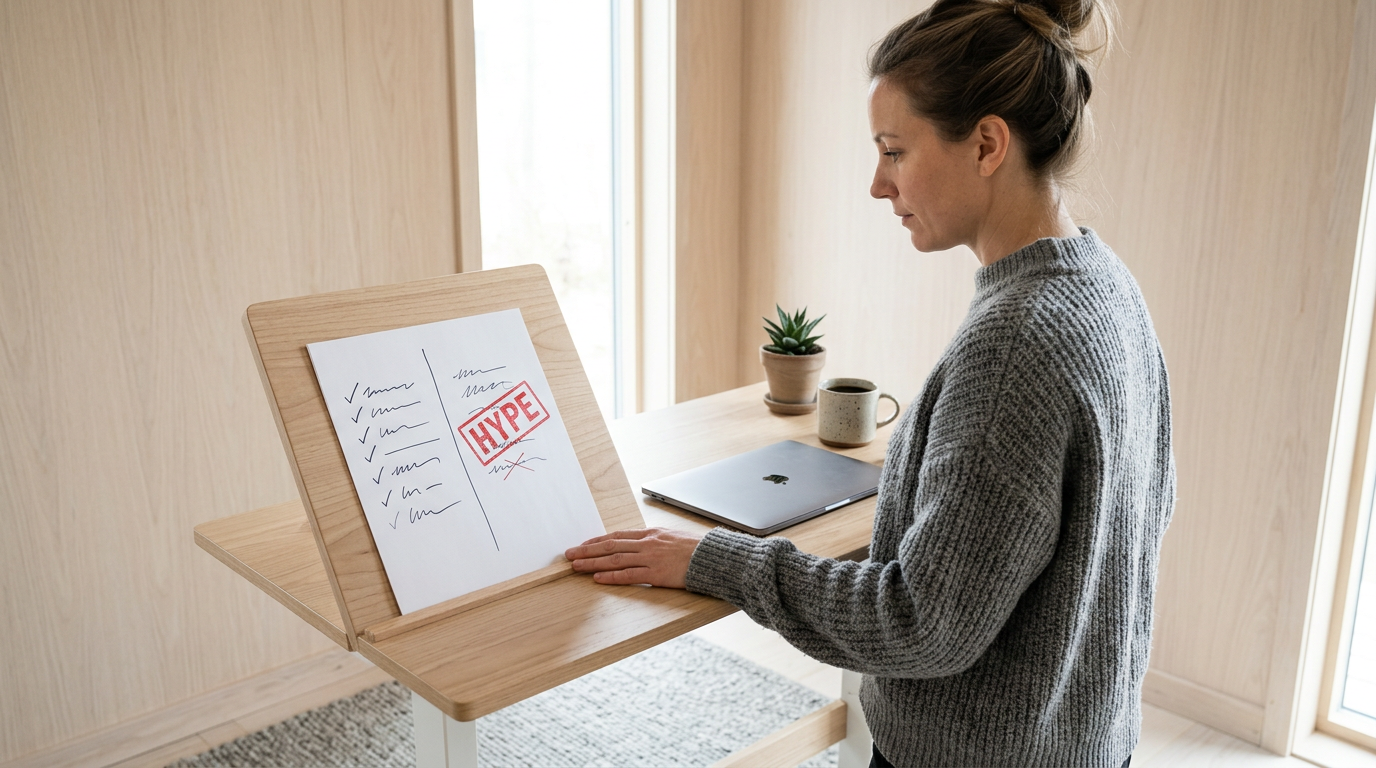
Standing desk benefits come mainly from breaking up long periods of sitting, not from standing all day. Alternating sitting, standing, and light movement may ease some back and upper-body discomfort and help moderate blood sugar after meals, while calorie, mood, and productivity gains are limited or uncertain. Use a well-adjusted sit-stand desk to change positions regularly, and sit or move when standing causes fatigue.
Think about the last marathon gaming session you had. You sat down after dinner to play one more match, and somehow it was past midnight with a stiff back and numb legs.
A standing desk promises to fix that, but not every benefit you’ve seen online holds up. Some claims are worth taking seriously, and others are pure hype.
In this post, we’ll separate the solid gains from the overblown claims, look at what standing does for your back and energy, and show you how to choose a budget sit-stand desk for long sessions.
Standing Desk Benefits for Long-term Health
Standing up during the day has real, research-backed upsides and a few overhyped claims. Here’s where the line falls.
Steadier blood sugar and insulin after meals
Think of a player who stands for a few minutes after dinner before queuing for the next match. That’s the kind of break the research looked at, and it costs nothing.
The strongest evidence is on post-meal blood sugar spikes.
A systematic review and meta-analysis in Obesity Reviews found that breaking up sitting lowered the glucose and insulin rise after meals, with an effect size of about 0.30 (a standard way to gauge a difference). That’s real, but not a miracle.
A randomized crossover trial from the UK Health Security Agency found that regular breaks lowered post-meal blood sugar in middle-aged adults without metabolic problems.
The insulin evidence is thinner. These studies measured how much insulin rose after meals, not how well your body handles it over time, so treat the claim that standing improves insulin sensitivity as unproven here.
Protecting your heart and circulation
The verified research we have doesn’t include figures on cardiovascular risk markers, circulation, or sedentary-related heart risk, so we won’t claim a measured benefit.
Apply one test to heart claims you see online: is there a named study and a number behind them?
The health toll of sitting all day
The phrase “sitting is the new smoking” is catchy, but the Heart Foundation calls it an analogy, not an evidence-based equivalence. Sitting and smoking both carry health effects, but the two can’t be directly compared.
Reducing daily sitting time is the practical takeaway, and the studies above tested breaking up long stretches. Our verified sources don’t quantify links to chronic disease or brain health and aging, so we’re keeping those general.
Burning extra calories and managing weight
A study of energy use during sitting, standing, and walking found that standing burns more calories per hour than sitting, but the extra is modest. We don’t have a verified per-hour figure, so be wary of precise numbers online.
Given how small the gap is, standing is one piece of weight management, not a fix on its own. The concept behind this is non-exercise activity thermogenesis (NEAT), the energy you burn through everyday movement outside planned exercise.
A player who stands through a long session and paces during loading screens adds a little NEAT without changing anything else about their night.

Easing Back Pain and Improving Posture
Long sessions can strain your neck, back, and shoulders. A sit-stand desk can help, but the gains depend on how you use it, so here’s what the evidence supports.
Less neck, shoulder and upper back discomfort
Hunching over a keyboard keeps your neck, shoulders, and upper back working. Standing lets you open up, which can mean less upper back discomfort and some neck and shoulder relief.
Studies of standing-desk use have reported percentage drops in back-pain symptoms. One study on office standing workstations found that adding extra contact points reduced self-reported low back pain by 47%.
Treat those numbers as a reason to try a setup, not a guarantee.
Standing rather than sitting can ease pressure on your spinal discs, according to a numerical study of sitting posture, which found that prolonged sitting raised fluid pressure inside the lower back discs compared with standing.
Keeping your spine in a neutral curve
A neutral spine keeps your back’s natural S-curve, rather than rounding into a slump. Your core muscles stay engaged too, since they’re working to keep you upright instead of leaning on a backrest.
The payoff is a more confident posture you can hold rather than slump out of.
Why switching positions matters most
The benefits seem tied to alternating positions, not to standing nonstop. That same study also found its extra contact points prompted more small body movements.
Static standing can strain you too. Think of a player grinding through a long raid night. They stand for the opening pulls, sit for the slower stretches, and stand again when the next boss starts.
No single position gets held for hours. Movement is the point.
Mental, Energy and Work Gains from Standing
Some standing claims have research behind them, and some don’t.
Lifting mood, easing stress and fatigue
You may feel a better mood, less stress and fatigue, or a natural energy boost, but the research we have doesn’t measure those things. Count them as bonuses.
Take a player who sits through a workday, then stands for the warm-up before a three-hour ranked session. That energy may carry into the evening, but no source here tests it.
Sharper focus and memory while standing
A systematic review and meta-analysis in the International Journal of Behavioral Nutrition and Physical Activity linked breaks from sitting that included standing or physical activity to better executive function (the brain’s planning and control skills) and memory.
Executive function is the closest the research gets to concentration. Blood flow to the brain isn’t tested here, so don’t count on it.
Of the two, memory showed the larger effect, but whether standing affects neurogenesis (the growth of new brain cells) is unsettled. Our sources don’t cover creative problem-solving, so treat it as a fun experiment.
Getting more done on the job
The evidence is mixed. A systematic review of active workstations found sit-stand desks had no detrimental effect on performance, though some treadmill and cycling setups showed possible drops. Standing didn’t hurt, but it isn’t a guaranteed boost.
You may see a call centre study with a 45% figure, but we couldn’t confirm its details, so treat it as a headline. If back pain slows you down, a sit-stand desk lets you change position, though our sources don’t measure productivity for that group.
Workplace vitality and collaboration aren’t measured here, but you might find it easier to chat with a teammate.

Using Your Standing Desk the Right Way
Got the desk? The goal isn’t to stand all day but to switch positions often enough that you don’t stiffen up.
How long should you stand each day?
Try one of these rhythms:
- 30/30 rule: 30 minutes standing, then 30 sitting.
- 45/15 rule: 45 minutes sitting, then 15 standing.
- Alternate every 30 to 60 minutes: Switch on a timer if a fixed split feels rigid.
The 20/8/2 rule splits each 30-minute cycle into 20 minutes sitting, 8 standing, and 2 moving. Over an eight-hour day, that’s about two hours on your feet, the same as the 45/15 split.
The 30/30 split doubles that to four, so two to four hours is a practical daily target.
New to standing? Start with short blocks and lengthen them as your legs adjust. Listen to your body and sit down if your feet, calves, or lower back start to complain. Standing should feel like a tool, not a test.
Setting your desk and screen height
Set your desk first:
- Elbows at 90 degrees: Forearms rest level on the desk, with elbows forming a right angle.
- Neutral wrists: Keep them straight while you type and aim, not bent up or down.
- Monitor at or below eye level: Look at the screen level or slightly down, not craning up.
Add-ons that make standing easier
- Anti-fatigue mat: Cushioning eases strain on your feet and legs.
- Supportive footwear: Real support beats socks or worn-out sneakers.
- Ergonomic chair: You’ll still sit plenty, so it keeps those blocks comfortable.
- Light desk movements: Shift your weight or take a small step now and then.
- Stand during queue times: Matchmaking and loading screens are natural moments to stand up.
Think of a ranked grinder who stands through every matchmaking queue. They log real standing time without losing a minute of play.
What Are the Downsides of Standing Desks?
Standing desks have real but manageable downsides: leg fatigue, varicose veins, and back strain. Some health claims don’t hold up either.
Leg fatigue, varicose veins and back strain
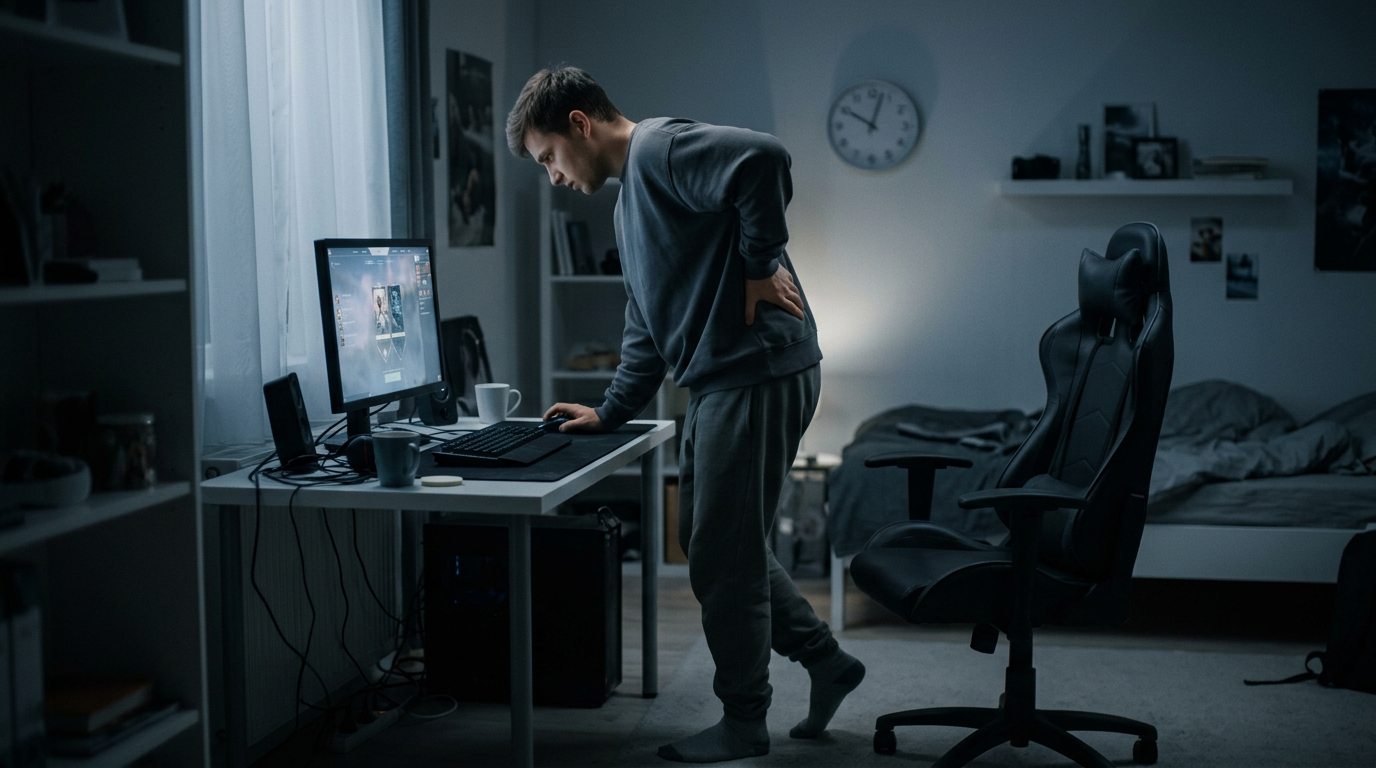
Leg and foot fatigue usually shows up first. Picture grinding ranked matches for three hours: by the second hour your calves ache, so sit or shift your weight. Don’t push through it.
Prolonged standing is linked to a higher risk of varicose veins. The National Research Centre for the Working Environment found men who mostly stood at work had a risk ratio of 1.85, roughly 85 percent higher than other men.
Lower back strain is the risk when your setup is off. A monitor set too low makes you hunch, and your lower back pays for it.
If you’re pregnant, check with your doctor before standing for long stretches.
Is standing three hours good? Not as one unbroken block, so break it up with sitting or a short walk.
Standing won’t replace real exercise
A standing desk isn’t a workout. The real gain is incidental activity, the small everyday movement like shifting or stretching. It helps, but it’s no substitute for a planned workout.
Health claims the evidence doesn’t back
- Lifespan extension unproven. No solid evidence yet shows standing desks add years to your life.
- Productivity evidence mixed. According to a paper on active workstations, the evidence on productivity is mixed, though sit-stand models had no detrimental effect on performance.
- Calorie burn marginal. A study on sitting, standing, and walking found swapping sitting for standing may not change calorie burn much, but swapping for walking does.
- Sitting-smoking comparison overstated. McGill University’s Office for Science and Society notes that sitting and smoking carry different risks, so the comparison is overstated.
Picking the Right Standing Desk
Here’s how we’d narrow it down: by how the desk moves, what it holds, and what it costs in Canadian dollars.
Electric, manual and converter desks
Electric desks move with a motor and buttons, while manual desks use a crank. Electric is quicker to adjust, but manual has fewer parts to fail. A converter sits on the desk you own, while a full desk replaces it.
Corner and specialty shapes fit odd rooms, so check the surface still works.
What to check before you buy
Start with height presets, the buttons that save your favourite seated and standing heights.
Next, check weight capacity and stability: make sure the rated limit covers your monitors, arm, and PC, and that the frame stays steady at full height. Wobble ruins focus.
Measure the surface against your gear, keyboard and mouse included. For dual monitors, you need width for both screens and depth to keep them an arm’s length away.
Listen for a smooth, quiet motor that won’t stutter or grind, especially if you game late. Set your budget first, then compare final prices in CAD with shipping and taxes included.
Leave enough cord slack to reach full height and back without catching. Think of a gamer on a fixed budget with two monitors who skips wobbly desks, picks one rated for the whole setup, and keeps the screens steady through long sessions.
Brand lineups, office fit-outs and accessories
Brand desk lineups differ in size and features, so compare models in the same tier, not by the name. Office fit-out furniture is built for workplaces, so it’s often more desk than a home gamer needs.
Monitor arms free up surface space and lift screens to eye level.
A standing desk won’t solve everything, and it doesn’t have to. Keep the claims that hold up, skip the ones that don’t, and let the desk do its real job: making it easy to shift positions during a long session.
Choose a sit-stand desk that fits your room and your budget, set the height so your screen sits at eye level, and don’t feel guilty about sitting back down. Give yourself permission to move, and your long sessions will feel a lot less long.
References
- An ergonomic intervention to minimise physical and physiological stresses in the office standing workstation — pubmed.ncbi.nlm.nih.gov (2025)
- Numerical study on the effect of sitting posture on biomechanical and biochemical signals within the lumbar intervertebral discs — doi.org (2026)
- The Acute Effects of Interrupting Prolonged Sitting With Regular Activity Breaks on Postprandial Glucose and Insulin in Adults: A Systematic Review and Meta‐Analysis - Gale - 2026 - Obesity Reviews — onlinelibrary.wiley.com (2026)
- The acute effects of breaking up seated office work with standing or light-intensity walking on interstitial glucose concentration: A randomized crossover trial — researchportal.ukhsa.gov.uk (2025)
- The Acute Effects of Interrupting Prolonged Sitting With Regular Activity Breaks on Postprandial Glucose and Insulin in Adults: A Systematic Review and Meta‐Analysis — doi.org (2026)
- The Impact of Active Workstations on Workplace Productivity and Performance — wisdomlib.org (2025)
- Is Sitting the New Smoking? | Office for Science and Society — mcgill.ca (2026)
- Acute cognitive effects of interruptions to prolonged sitting with brief standing or physical activity breaks: a systematic review and three-level meta-analysis | International Journal of Behavioral Nutrition and Physical Activity — link.springer.com (2026)
- Energy Expenditure During Acute Periods of Sitting, Standing, and Walking — pubmed.ncbi.nlm.nih.gov
- Is Sitting Really the New Smoking? — pmc.ncbi.nlm.nih.gov
- The Impact of Active Workstations on Workplace Productivity and Performance: A Systematic Review — pmc.ncbi.nlm.nih.gov (2018)
- Is Sitting The New Smoking? — theheartfoundation.org
- Standing at work and varicose veins — nfa.elsevierpure.com
Questions
What is the 20/8-2 rule for standing desks?
The 20/8/2 rule divides each 30-minute cycle into 20 minutes sitting, 8 minutes standing, and 2 minutes moving. Repeating it across an eight-hour day adds up to about two hours of standing.
What are the downsides of using a standing desk?
Standing desks can cause leg and foot fatigue, varicose veins with prolonged standing, and lower-back strain if your setup is poor. Standing still for long stretches can be uncomfortable, and a standing desk does not replace exercise.
How many hours a day should you stand at your desk?
A practical target is about two to four hours of standing over an eight-hour workday, spread across short periods rather than one long stretch. Alternate between sitting, standing, and moving every 30 to 60 minutes, and adjust if you feel discomfort.
Is standing for 3 hours good for you?
Standing for three hours total can fit within a practical daily range if you break it into shorter periods and alternate with sitting or walking. Three hours in one uninterrupted block is not recommended, since prolonged static standing can cause fatigue and strain.
Sources
- An ergonomic intervention to minimise physical and physiological stresses in the office standing workstation - PubMed, pubmed.ncbi.nlm.nih.gov,
- Numerical study on the effect of sitting posture on biomechanical and biochemical signals within the lumbar intervertebral discs, doi.org,
- The Acute Effects of Interrupting Prolonged Sitting With Regular Activity Breaks on Postprandial Glucose and Insulin in Adults: A Systematic Review and, onlinelibrary.wiley.com,
- The acute effects of breaking up seated office work with standing or light-intensity walking on interstitial glucose concentration: A randomized crossover, researchportal.ukhsa.gov.uk,
- The Acute Effects of Interrupting Prolonged Sitting With Regular Activity Breaks on Postprandial Glucose and Insulin in Adults: A Systematic Review and, doi.org,
- Energy Expenditure During Acute Periods of Sitting, Standing, and Walking - PubMed, pubmed.ncbi.nlm.nih.gov
- The Impact of Active Workstations on Workplace Productivity and Performance: A Systematic Review, pmc.ncbi.nlm.nih.gov,
- Is Sitting Really the New Smoking? - PMC, pmc.ncbi.nlm.nih.gov
- The Impact of Active Workstations on Workplace Productivity and Performance, wisdomlib.org,
- Is Sitting the New Smoking? | Office for Science and Society - McGill University, mcgill.ca,
- Is Sitting The New Smoking? - The Heart Foundation, theheartfoundation.org
- Standing at work and varicose veins - The National Research Centre for the Working Environment, nfa.elsevierpure.com
- Acute cognitive effects of interruptions to prolonged sitting with brief standing or physical activity breaks: a systematic review and three-level, link.springer.com,
Free · The Build Sheet
The Build Sheet: three gaming PCs priced at Canadian stores