Memory Prices Chart Guide: Spot, Contract and Retail
Memory prices chart shows how spot, contract, and retail rates differ, with Canadian RAM kit prices and a clear buy-or-wait signal for your next upgrade.

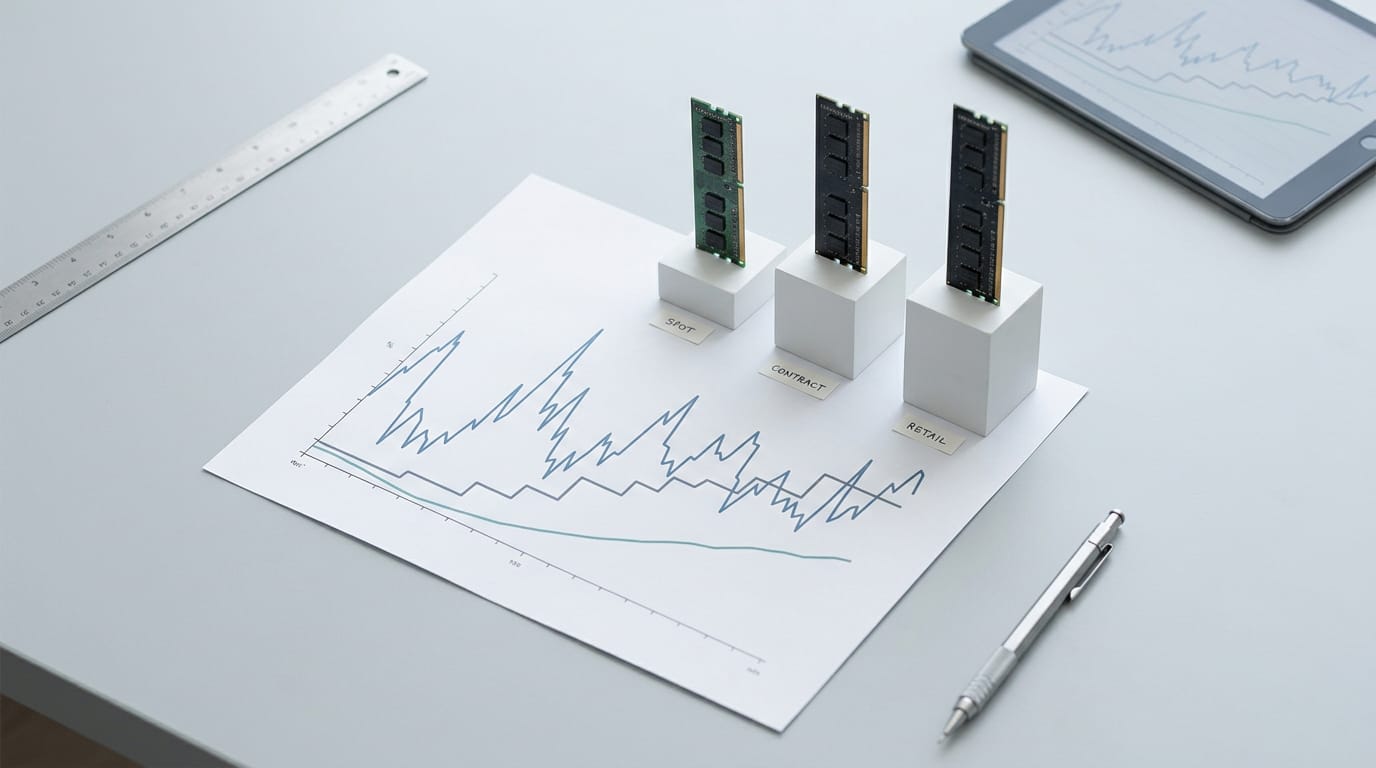
A memory prices chart tracks the cost of computer memory and storage, from chip prices to the RAM kits and SSDs shoppers can buy. Spot prices show immediate market moves, contract prices reveal the broader direction, and retail prices show what you will actually pay; historical charts help distinguish a lasting trend from a short-term swing. Compare matching products and check current Canadian store prices, since retail can lag market changes and future price drops are not guaranteed.
Think of a memory price chart like a grocery flyer that shows what a wholesaler pays next to the shelf price.
RAM (random access memory, the short-term workspace your PC uses while games run) moves through a similar ladder, and each rung tells you something different.
This post breaks down the three main price types: spot, contract, and retail. We’ll show you how to read each one, then take it to Canadian stores with RAM kit pricing in Canadian dollars and a clear buy-or-wait read for your next upgrade.
Today’s Memory Prices Chart, Spot and Contract
How are memory prices right now? They shift daily, so check the date on the chart before you act.
Spot prices for DRAM chips and modules
DRAM (dynamic random-access memory) is your PC’s system memory. Spot prices show what DDR5, DDR4, and DDR3 chips (DDR means double data rate) cost right now, and the session high/low shows the day’s range.
UDIMMs (desktop memory sticks) and RDIMMs (registered server modules) get their own prices. Players mostly watch UDIMMs.
Picture a gamer weighing a DDR4 build against DDR5 this weekend. If DDR5 climbs while DDR4 stays flat, that gap shows whether the older platform is worth a look.
Monthly and quarterly contract price updates
Contract prices are agreed in bulk, so they smooth out daily noise. They reveal direction, while spot prices reveal timing.
- DRAM monthly contract prices: the month’s agreed price for memory chips.
- NAND flash contract prices: the storage chips inside solid-state drives (SSDs) and memory cards.
- Mobile DRAM and eMMC: phone and laptop memory, plus eMMC (embedded storage).
- Quarterly TrendForce updates: a market research firm’s wider view.
Will memory prices go up in 2026? Nobody can promise that, so we won’t guess. Watch whether monthly and quarterly updates keep pointing the same way. Trends beat single jumps.
Prices for flash, SSDs and other memory
- SLC, MLC, and TLC flash spot: single-, two-, and three-bit flash (SLC, MLC, TLC). Fewer bits usually means pricier per gigabyte.
- NAND wafer prices: the silicon discs that flash chips are cut from.
- SSD street and OEM prices: shelf prices, plus OEM (original equipment manufacturer) bulk rates for PC makers.
- GDDR, LPDDR, and memory cards: GDDR is graphics card memory, LPDDR (low-power DDR) runs phones and laptops, and cards use NAND flash.
Where Consumer RAM Kit Prices Stand Today
RAM (random access memory) prices swing hard, so start with what a kit (sticks sold together) costs today.
Compare DDR5 and DDR4 kit prices
To read the chart, start with the generation your motherboard supports: DDR5 (double data rate 5, the newer standard) or DDR4 (its predecessor). Then check each kit against this list:
- Best current U.S. price: the lowest price on offer right now.
- Lowest-ever price: the cheapest the kit has been, so you can spot a spike.
- Capacities and speeds: compare like with like, matching size and speed (MT/s, or megatransfers per second).
- Lowest price, any brand: a lesser-known brand with matching specs can beat a name you recognize.
- Canadian-dollar prices: U.S. figures don’t show what you’ll pay in Canada, so check Canadian-dollar listings directly.
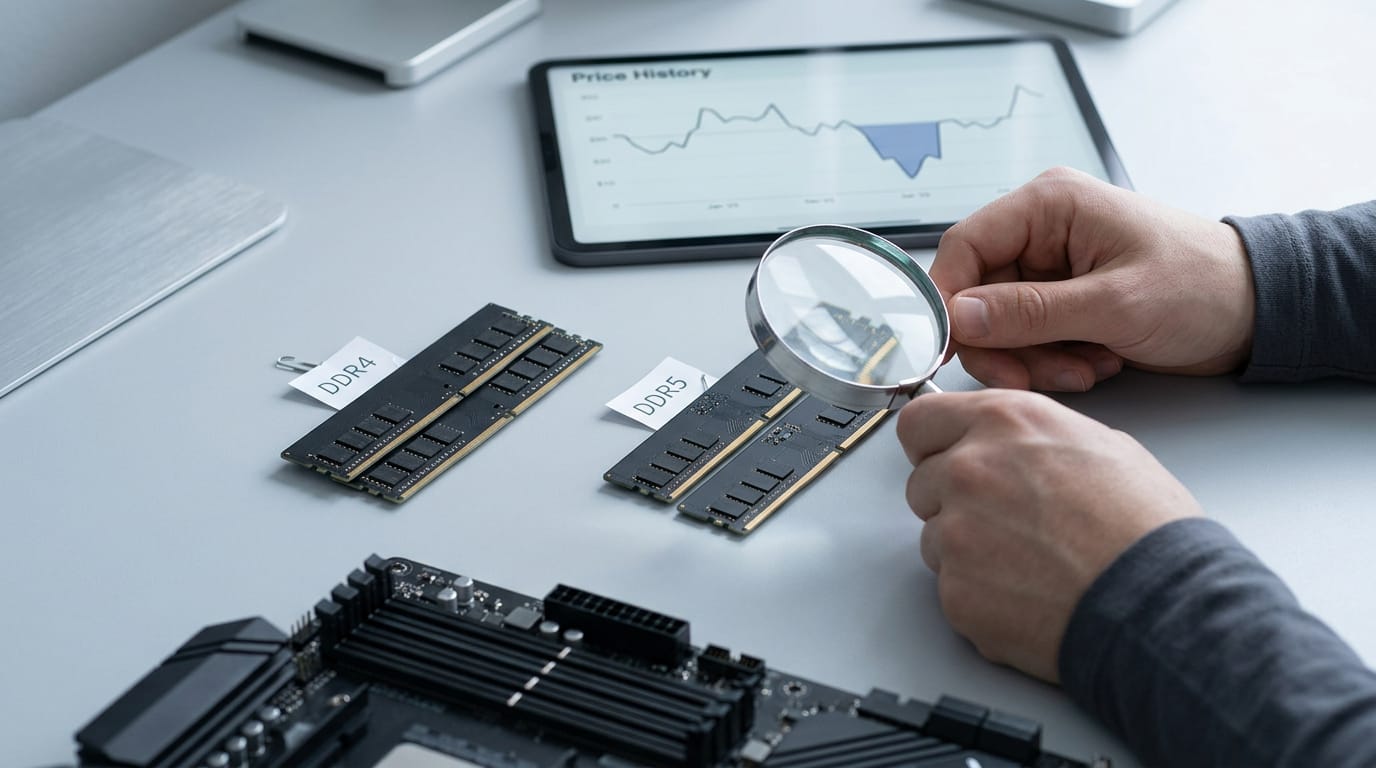
RAM price surge and the buying squeeze
DDR5 prices have tripled or quadrupled. Samsung has reportedly doubled the contract price of DDR5 memory, according to Interesting Engineering, and a contract price is a negotiated bulk price, not a shelf price.
Older DDR4 fared no better: Tom’s Hardware reports that its prices have nearly tripled in just two months.
Other pressures pile on:
- Stock shortages: thin supply means popular kits sell out fast.
- Scalpers and bots: resellers and automated buyers can grab stock before you do.
- Bundling and markups: some sellers pad prices with bundles, so price the kit on its own.
Think of a player whose DDR4 PC is stuttering in their favourite game. They buy a kit that fits their board now and get back to gaming this week instead of gambling on a drop.
Buy now or wait? If the build or repair can’t wait, buy at today’s price. If you can wait, watch the lowest-ever figure. Are RAM prices going down in 2026? The reports we have don’t promise a drop, and the latest ones show prices climbing.
Plan around the price you can see, not the one you hope for.
Historical Memory Price Charts over Time
Before you buy, know where memory prices have been, not just where they sit today. Here’s how we read these charts.
Cost per GB for each memory type
Charts plot each type as cost per GB (dollars per gigabyte):
- DRAM: dynamic random-access memory, your PC’s system memory
- NAND: flash storage in solid-state drives (SSDs)
- HBM: high-bandwidth memory
- Hard disk drives
A log scale spaces steps by percentage change, so the lowest $/GB readings stay visible next to the highest.
A toggle switches between nominal and inflation-adjusted prices. Nominal shows what you paid; inflation-adjusted shows what it’s worth.
Long-run lines draw on the McCallum historical dataset.
Comparing prices across memory generations
Compare each generation with itself over time.
Say you’re a player on an older DDR (double data rate) system, weighing a DDR5 upgrade. A steady slide suggests waiting is paying off; a jumpy line means prices could swing either way.
The same logic applies to HBM, from HBM2e to HBM4. Its $/TB/s line (dollars per terabyte per second) measures bandwidth, not capacity, so don’t compare it straight to a $/GB figure.
Older generation points are approximate, so read them as direction.
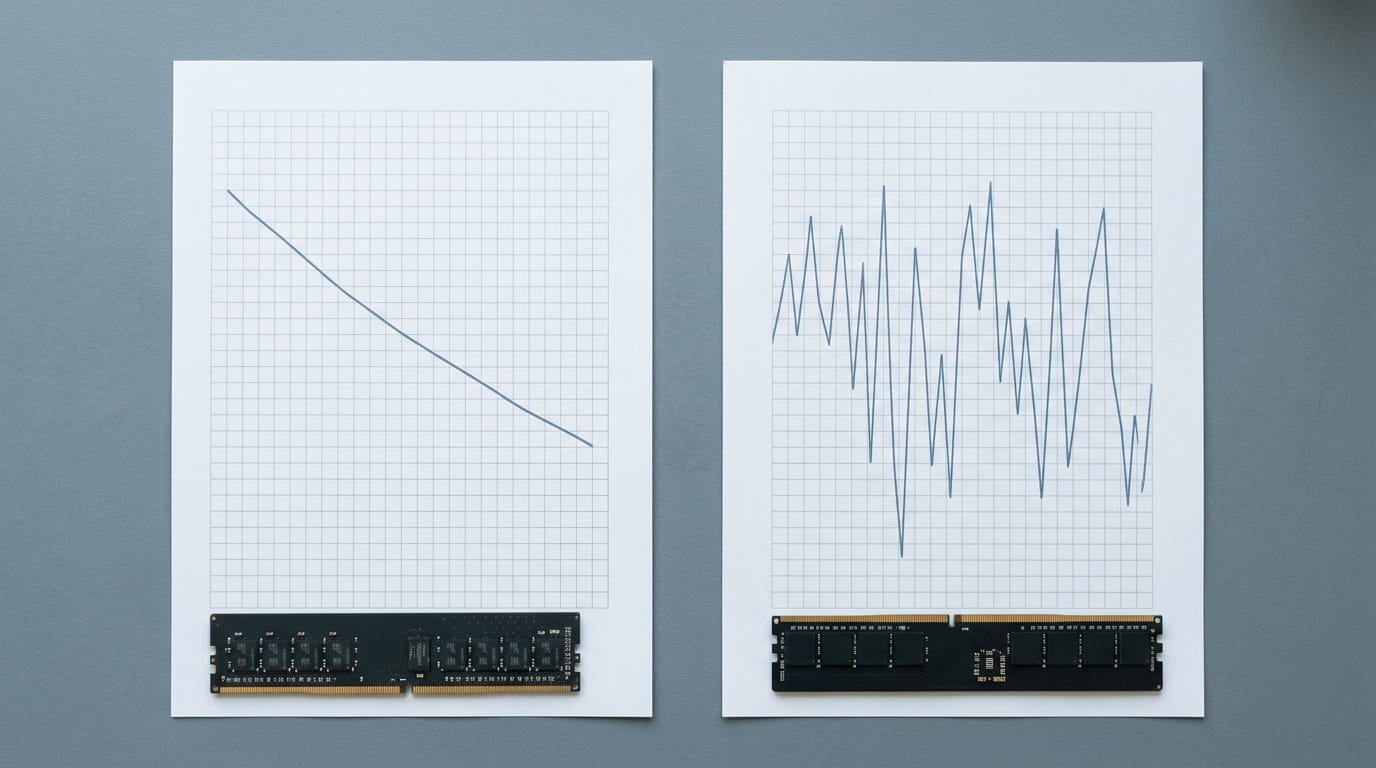
Boom and bust cycles, plus market forecasts
Memory prices run in cycles. Supply and demand modeling shows how shortages push prices up and gluts pull them down. Super cycles are long, steep climbs; collapses are sharp drops.
Charts also show semiconductor revenue forecasts and memory company earnings. Forecasts are a best guess; earnings show what actually happened.
If you’re a builder waiting on a memory deal, ask whether a line is a dip in a rising trend or the start of a bust. Read the trend, not the tag.
Why Is DRAM Pricing Increasing?
Short answer: demand from artificial intelligence (AI) is pulling on the factories that make dynamic random-access memory (DRAM), better known as RAM, and those factories can’t expand overnight.
Here’s how that squeeze works, plus the theories readers have.
How AI demand is squeezing memory supply
Spending on AI is extraordinary right now, and that money flows straight into memory orders. The sharpest pinch comes from high-bandwidth memory (HBM), the specialized type AI chips use. A wafer is the round silicon disc that chips are cut from.
According to Tom’s Hardware, “Each gigabyte of HBM consumes roughly three times the wafer capacity of DDR5.” That means every wafer spent on HBM is one that can’t make DDR5, a standard type of RAM.
Some production that once served consumer RAM has shifted to enterprise products, the memory that businesses and servers buy. The issue is less about how much memory gets made and more about where it goes.
Building a fabrication plant (fab) takes time, so new supply can’t keep pace. That’s the squeeze.
Think of a builder who budgeted for a 32-gigabyte DDR5 kit and now finds it priced above their spreadsheet number. The RAM hasn’t changed, but the math has, so re-check the budget before checkout.
Readers’ theories on who is to blame
Readers have a few theories about who’s responsible:
- AI gets the blame. Many readers point to AI as the main culprit.
- Price-fixing suspicions. Some readers suspect manufacturers are coordinating prices, but suspicion isn’t proof, and the sources here don’t establish it.
- Manufacturer profit motives. Others argue makers are raising prices to protect their margins.
- Prices plateauing or falling. A few readers report prices levelling off or dropping.
You don’t need to settle the blame game to shop smart. Focus on the price in front of you.
What HBM and AI Chips Really Cost
Ever wondered where artificial intelligence (AI) hardware costs come from? We’ll show you why the figures are rarely what they look like at first glance.
Breaking down what AI accelerators cost
AI accelerators are chips built to train and run AI models. Epoch AI’s modeled estimates split each chip’s cost into four parts:
- high-bandwidth memory (HBM)
- logic (the processing die)
- packaging
- auxiliary components
Those estimates cover Nvidia, AMD, Google, and Amazon accelerators. They’re then rolled into a quarterly volume-weighted average, which weighs each price by how many units sold at it.
That’s a tidy figure, but it’s still an average, not a bill for any one chip.
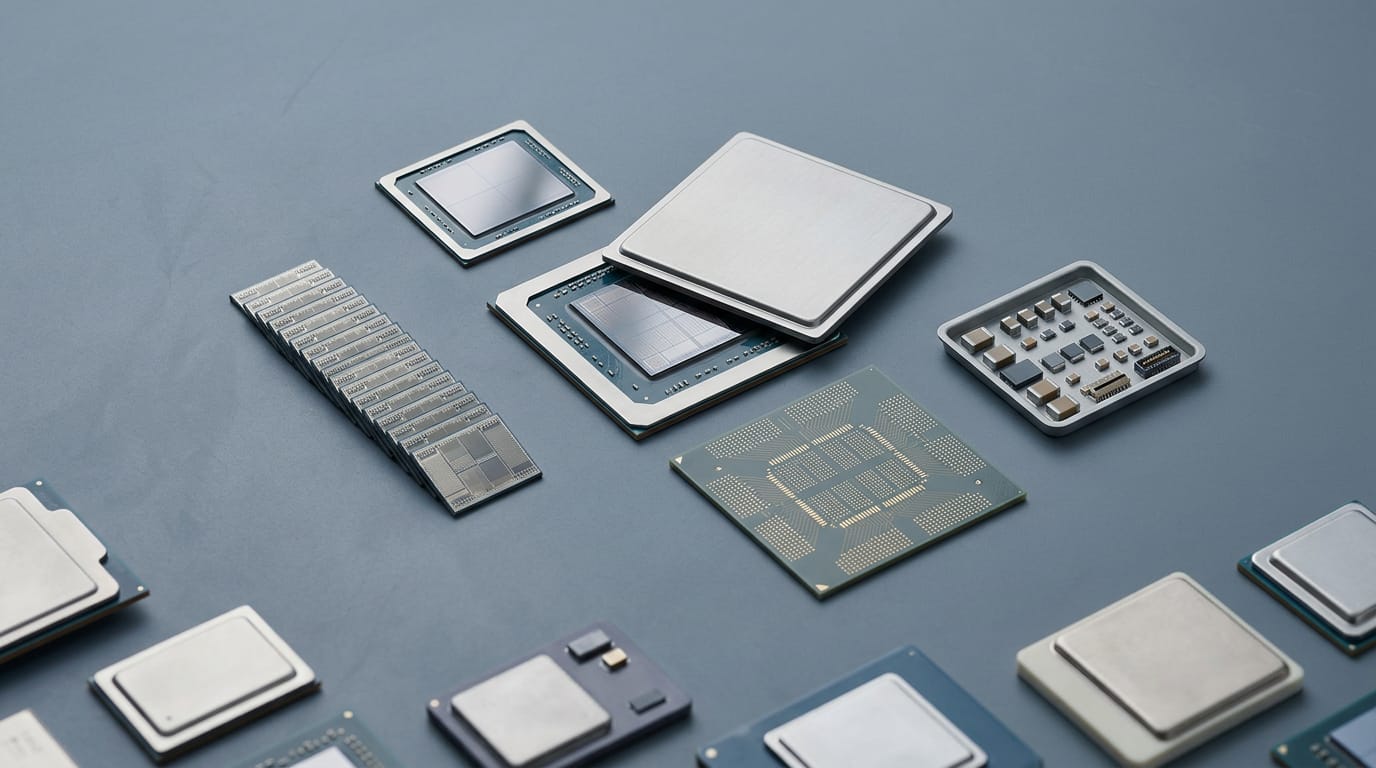
Why HBM pricing is hard to verify
HBM isn’t sold on a shelf, so there’s no price you can check yourself. You’re seeing what a chip should cost, not what anyone paid. Four things make these numbers hard to pin down:
- No public spot market. Nothing trades openly, so there’s no live price to compare.
- Confidential contracts. Terms are agreed privately and stay out of view.
- Analyst estimates, not transactions. It’s a model, not a record of a sale.
- HBM4 projected. The next generation, HBM4, is still a forecast.
Think of a builder with a firm budget who reads that AI memory costs jumped and wonders if their next memory kit will follow. The chart can’t settle that.
Its HBM figures come from models and private deals, so the builder’s real move is to watch the kit prices they can actually buy at Canadian stores.
Our Data Sources and Their Limits
Every line on a memory chart reflects a method with blind spots. Here’s how ours works and where it can mislead you.
How the price data gets collected
The chart draws on McCallum’s dataset and Keepa, a price-history tracker for Amazon listings. For retail, we record the cheapest listed retail price, the best deal on offer rather than a typical one.
It refreshes monthly, and the data is a downloadable CSV (comma-separated values file) you can check yourself.
Where these prices can mislead you
Say a player replacing dead RAM sees the line falling and assumes the shelf dropped too. Retail lags contract prices, so checking the shelf first keeps you from chasing a drop that hasn’t arrived. The chart shows the market, but your cart shows the shelf.
End-of-life clearance of discontinued memory can drag a line down without reflecting the wider market. The chart also splices two datasets at mid-2024, so a bend there may come from the join, not the market.
Obvious glitches are filtered out, and some points are modeled estimates, calculated rather than observed. Treat those as a guide, not a receipt.
How spot, contract and street prices update
Three prices show up on the same chart, and they move at different speeds:
- Spot: memory you can buy right now.
- Contract: the negotiated price big buyers lock in.
- Street: what you pay at a retail shelf.
A spot move has to work through contract pricing before it reaches the shelf, so retail trails the chart. Always check the last-update timestamp, since a monthly chart can run up to a month behind.
TrendForce methodology changes can move a line on their own, so a sudden jump may be a new counting method, not a market shift.
Spot, contract, and retail prices each answer a different question. Spot shows where the market sits right now, contract shows where large buyers are locked in, and retail shows what you’ll actually pay at a Canadian store.
Read them together, and the chart stops being noise.
Match those readings to your own budget and timing, and don’t chase the lowest number on a single day. The chart shows the trend, but your budget and your games should decide when you click buy.
References
- Samsung hikes DDR5 prices 100%, reshaping device pricing in 2026 — interestingengineering.com
- Insane DDR4 price spikes mean last-gen RAM loses its value luster versus DDR5 — prices have nearly tripled in just two months — tomshardware.com (2025)
- Here’s why HBM is coming for your PC’s RAM — HBM consumes around three times the wafer capacity of DDR5 per gigabyte, as AI supercharges demand for chips and advanced packaging — tomshardware.com (2025)
Questions
How are memory prices right now?
Memory prices are volatile and vary by type and market. Recent reports show DDR5 prices have tripled or quadrupled and DDR4 prices have also climbed sharply, while spot, contract, and retail prices can move at different speeds.
Why is DRAM pricing increasing?
AI demand is increasing orders for high-bandwidth memory (HBM), which uses substantially more wafer capacity per gigabyte than DDR5. Manufacturers are also shifting some production toward enterprise memory, and new fabrication plants take time to build, limiting how quickly supply can respond.
Are memory prices declining?
There is no clear sign of a broad decline: recent reports show prices climbing, though some buyers report prices leveling off or dropping. Memory prices are cyclical, so check current listings and longer-term trends rather than relying on a single price move.
Are memory prices rising?
Yes. Recent reports show sharp increases in both DDR5 and DDR4 prices, driven in part by tight supply and strong AI-related demand. Prices vary by product and can change over time.
Will memory prices go up in 2026?
No one can reliably promise whether memory prices will rise in 2026. Watch monthly and quarterly contract-price updates alongside current retail prices, since forecasts and individual price jumps do not guarantee what shoppers will pay.
Is the DRAM price going down?
There is no reliable indication that DRAM prices are broadly going down right now. Recent reports point to rising prices, although individual products or listings may level off or fall.
Are DRAM memory costs falling?
DRAM costs are not broadly reported as falling; recent reports instead describe steep increases in DDR5 and DDR4 prices. Spot, bulk contract, and retail prices can differ, and retail prices may lag changes elsewhere in the market.
Are RAM prices going down in 2026?
A general drop in RAM prices in 2026 is not guaranteed, and recent reports show prices climbing. If you can wait, track current retail prices and longer-term trends; if you need memory now, compare compatible kits at the price available.
Sources
- Samsung hikes DDR5 prices 100%, reshaping device pricing in 2026, interestingengineering.com
- Insane DDR4 price spikes mean last-gen RAM loses its value luster versus DDR5 — prices have nearly tripled in just two months | Tom's Hardware, tomshardware.com,
- Here's why HBM is coming for your PC's RAM — HBM consumes around three times the wafer capacity of DDR5 per gigabyte, as AI supercharges demand for chips and, tomshardware.com,
Free · The Build Sheet
The Build Sheet: three gaming PCs priced at Canadian stores